Florida Has No Estate Tax. Here's the Tax Bill Your Heirs Could Still Get.
One of the quiet perks of living in Florida is the tax picture. No state income tax. No state estate tax. No inheritance tax. For a lot of families who moved here from higher-tax states, that’s a genuine relief, and it’s often part of why they came.
But there’s a catch hiding inside that good news. “Florida has no estate tax” gets shortened, in a lot of people’s minds, to “there’s nothing to plan for.” And that’s simply not true. The federal estate tax still applies to Florida residents. A tax rule called step-up in basis affects far more families than the estate tax ever will. And the tools people assume will protect their heirs, a will, a joint account, a quick beneficiary form, don’t always work the way they think.
Here’s what “no estate tax in Florida” actually means, and the bill your family could still face if you take the headline too literally.
Does Florida have an estate tax? No, and here’s the full picture
Let’s be precise, because the words matter. There are three different taxes people mix up:
- Estate tax is paid by the estate of the person who died, before assets are distributed.
- Inheritance tax is paid by the person who receives the money.
- Federal estate tax is the version the IRS collects, separate from anything a state does.
Florida does not have a state estate tax, and it does not have an inheritance tax. The state constitution actually prohibits Florida from charging its own estate tax beyond what’s tied to the federal system, and that federal tie was phased out years ago. So on the state level, your heirs owe nothing to Tallahassee.
That’s real, and it’s worth appreciating. But it’s only two of the three taxes, and the third one didn’t go anywhere.
The federal estate tax still applies (even to Floridians)
The federal estate tax is a tax on the total value of everything you own when you pass away, your home, investment accounts, retirement accounts, life insurance you own, business interests, real estate, all of it. Florida residency doesn’t exempt you from it, because it’s a federal tax.
Here’s the part that puts most families at ease: the federal estate tax only kicks in above a very high exemption. For 2026, that exemption is $15 million per individual, or effectively $30 million for a married couple with proper planning. Estates below that threshold generally owe no federal estate tax at all. And under legislation passed in 2025, that $15 million level was made permanent and indexed to rise with inflation, rather than dropping back down as it was previously scheduled to.
For 2026, the federal estate and gift tax exemption is $15 million per individual (about $30 million for a married couple using portability). The annual gift tax exclusion is $19,000 per recipient, or $38,000 for a married couple splitting gifts. Florida has no state estate tax and no inheritance tax.
So for the large majority of Tampa Bay families, the federal estate tax isn’t the real concern. But if you own a successful business, significant real estate, or you’ve had a very good couple of decades in the market, this is exactly the number to keep an eye on, because everything you own gets counted, and the total adds up faster than people expect once you include a paid-off home and life insurance proceeds.
The married-couple math: how “portability” works
That $30 million figure for couples isn’t automatic, and misunderstanding it is one of the more expensive mistakes higher-net-worth families make. Each spouse gets their own $15 million exemption. When the first spouse dies, any exemption they didn’t use can be transferred to the surviving spouse, stacking on top of their own. That transfer is called portability, and it’s what gets a couple to a combined $30 million.
Here’s the catch: portability isn’t free or automatic. To claim the deceased spouse’s unused exemption, the surviving spouse’s estate generally has to file a federal estate tax return within a set window after the first death, even if no tax is owed and no return would otherwise be required. Families who assume the exemption “just carries over” sometimes skip that filing and permanently lose millions in shelter. If your combined assets are anywhere near the exemption, this is a filing decision worth making deliberately, not by default.
The tax that affects almost everyone: step-up in basis
Here’s the rule that matters far more for most families than the estate tax, and the one almost nobody brings up at the dinner table.
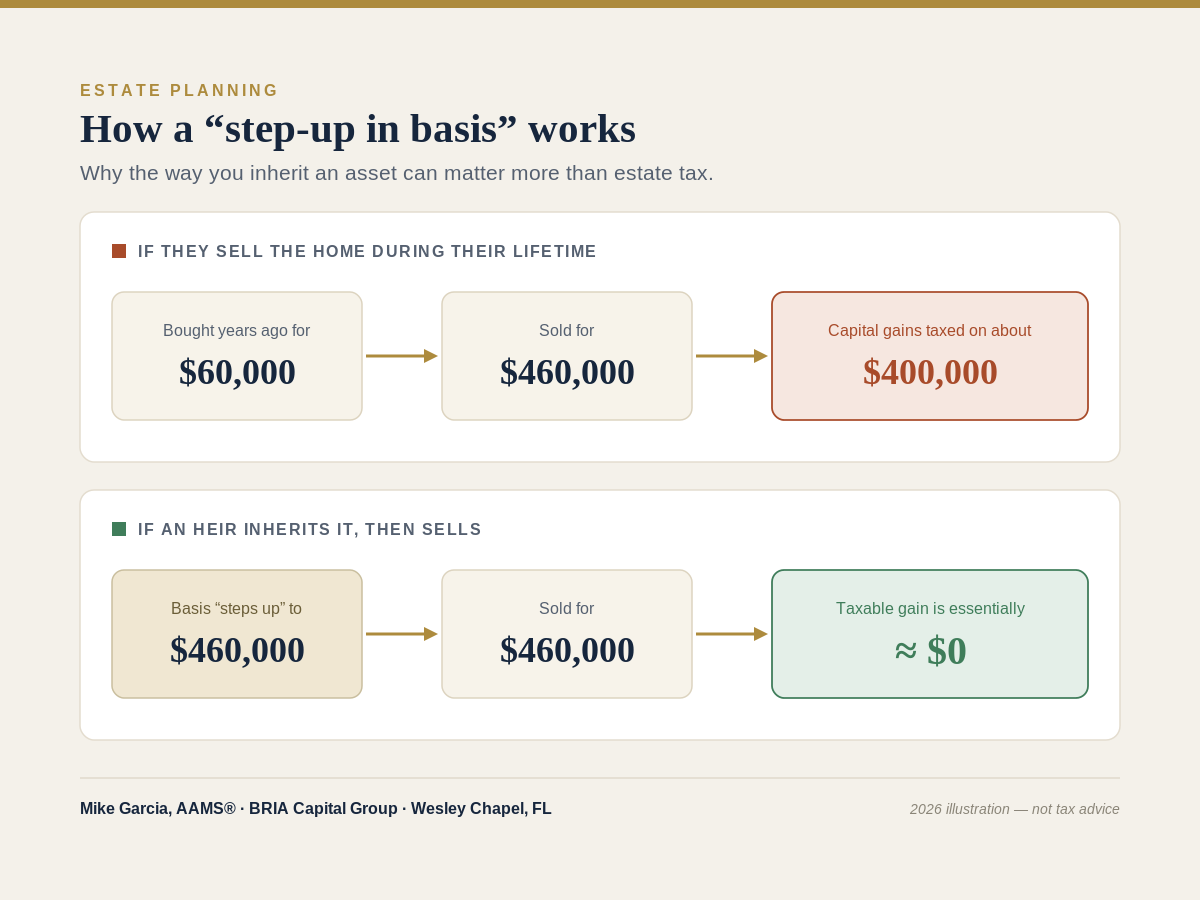
Step-up in basis deals with capital gains, not estate tax. When you inherit an asset, a house, a stock portfolio, its “cost basis” is generally reset to its fair market value on the date the original owner died. That reset is the “step-up,” and it can erase a huge amount of would-be capital gains tax.
An example makes it concrete. Say your parents bought a home in Pasco County decades ago for $60,000, and it’s worth $460,000 when they pass away. If they had sold it during their lifetime, they’d owe capital gains tax on roughly $400,000 of appreciation. But if you inherit it, your basis “steps up” to $460,000. Sell it shortly after for $460,000, and your taxable gain is essentially zero.
This is why how you pass an asset to your heirs can matter more than whether you owe estate tax. Well-meaning parents sometimes add a child to the deed of their home, or gift a highly appreciated stock during their lifetime, thinking they’re simplifying things, and accidentally give up a step-up that would have saved their family a serious tax bill. The intention is right; the mechanics quietly backfire.
Wills, deeds, and beneficiary forms often say different things. Let's make sure yours line up, in a no-pressure 30-minute conversation.
Book a free consultationGiving money away during your lifetime: the gift tax angle
Some people try to shrink their estate by giving money away while they’re alive. That’s a legitimate strategy, but it has its own rulebook.
For 2026, you can give up to $19,000 per recipient per year without any gift tax filing at all, that’s the annual exclusion. A married couple can combine to give $38,000 to the same person. Give more than that to one person in a year, and you don’t necessarily owe tax, but you generally have to file a gift tax return, and the excess counts against that same $15 million lifetime exemption we talked about above.
The takeaway isn’t “give money away to dodge taxes.” For most families, the estate tax exemption is so high that lifetime gifting is about goals, helping a child with a down payment, funding a grandchild’s education, not tax avoidance. And as the step-up example showed, gifting the wrong asset (a highly appreciated one) can cost more in capital gains than it ever saves in estate tax. Which asset you give matters as much as how much.
The Florida-specific tool worth knowing: the lady bird deed
Florida offers an estate-planning instrument that a lot of residents have never heard of: the lady bird deed, formally called an enhanced life estate deed.
In plain terms, it lets you keep full control of your home while you’re alive, you can sell it, mortgage it, or change your mind entirely, and have it pass automatically to a named beneficiary when you die, without going through probate. Because the transfer happens at death, the property also generally keeps that valuable step-up in basis for your heirs. It’s a popular tool in Florida precisely because it sidesteps the cost and delay of probate on what is usually a family’s biggest asset.
A lady bird deed is a legal document, and it isn’t right for every situation, it interacts with your mortgage, your homestead protections, and the rest of your estate plan. That’s why it should be drafted by a qualified Florida estate planning attorney, not pulled off a template website. Where it fits, though, it can be a clean, low-cost way to keep the family home out of probate.
How your assets actually pass, and why your will may not control it
Here’s the part that surprises people most: for many of your accounts, your will has no say at all. Retirement accounts, life insurance, and any account with a named beneficiary pass directly to whoever is listed on the beneficiary form, regardless of what your will says. A payable-on-death (POD) designation on a bank account or a transfer-on-death (TOD) registration on a brokerage account works the same way. These pass outside probate and outside your will entirely.
That’s powerful when it’s set up correctly, and quietly disastrous when it isn’t. The classic example is the ex-spouse who was never removed as the beneficiary on a 401(k) or life insurance policy, and legally inherits it years after the divorce, because the form was never updated. No will, no matter how carefully drafted, overrides that form. This is why “I have a will, so I’m covered” is one of the most common and costly assumptions in estate planning. Your beneficiary designations are part of your estate plan whether you treat them that way or not.

The single most common estate mistake I see in Tampa Bay has nothing to do with the estate tax, it's an outdated beneficiary form. An ex-spouse still listed on a 401(k), a grown child accidentally left off a life insurance policy, an account that never got updated after a big life change. Your will does not override those forms. When we build a plan, we sit down and check every beneficiary designation against what you actually want to happen. It takes an afternoon and it saves families real heartache.
Why probate is worth avoiding in Florida
When an asset doesn’t pass automatically, no beneficiary, no lady bird deed, no trust, it generally goes through probate, the court-supervised process of validating a will and distributing what’s left. In Florida, formal probate can take months, becomes part of the public record, and carries attorney and court costs that come out of the estate before your heirs see a dime.
None of that means probate is a catastrophe; plenty of estates go through it without issue. But most of the tools above, beneficiary designations, POD/TOD accounts, lady bird deeds, and living trusts, exist largely to keep specific assets out of it. The family home, in particular, is usually the asset most worth shielding, both because of its value and because probate delays can complicate an already stressful time. Knowing which of your assets would currently pass through probate, and which wouldn’t, is a simple but revealing exercise most families have never done.
Why this needs to be coordinated, not handled in pieces
Notice how many different areas just came up: federal tax law, capital gains, gifting strategy, real estate titling, probate, life insurance. Estate planning goes wrong most often not because someone picked the wrong single tool, but because the pieces weren’t talking to each other. The will says one thing, the beneficiary form on the IRA says another, the deed does a third thing, and the beneficiary designation almost always wins, regardless of what the will says.
This is where a financial advisor and an estate attorney work together rather than in separate rooms. An attorney drafts the wills, trusts, and deeds. As your advisor, my job is to make sure your investment accounts, retirement plans, life insurance, and beneficiary designations all line up with that legal framework, so the plan actually does what you intended when it matters. I don’t draft legal documents, and I don’t give tax advice; I coordinate the financial side and bring in the right attorney or CPA so nothing falls through the cracks.
The bottom line for Tampa Bay families
“Florida has no estate tax” is true, and it’s a real advantage. But it’s not the same as “there’s nothing to plan for.” The federal estate tax still applies above $15 million. Step-up in basis affects nearly every family that passes down a home or an investment account. Gifting the wrong asset can cost more than it saves. And the tools that keep your home out of probate only work if they’re set up correctly and coordinated with everything else.
If you’ve been telling yourself your estate plan is “handled” because you live in Florida, it’s worth a second look, especially if it’s been a few years, you’ve moved here from another state, or you own a business or property that’s grown in value.

Explore our estate planning services, learn more about inheritance and legacy planning and wills and power of attorney, or see how we serve families right here in Wesley Chapel. When you’re ready, book a no-pressure 30-minute call and we’ll talk through where your plan stands.
Mike Garcia, AAMS®, is a financial advisor with BRIA Capital Group, serving families and business owners in Wesley Chapel and across Tampa Bay from an office at 2044 Ashley Oaks Cir #102, Wesley Chapel, FL 33544.
This article is for general educational and informational purposes only and is not intended as, and should not be relied upon as, individualized tax, legal, or investment advice. Estate, gift, and capital gains tax rules are complex, contain exceptions, and can change; the figures cited reflect 2026 federal amounts and may be adjusted over time. Neither Mike Garcia nor BRIA Capital Group provides tax or legal advice. Wills, trusts, and deeds should be prepared by a qualified attorney, and tax questions should be directed to a qualified tax professional. Investing involves risk, including the potential loss of principal. Securities and advisory services offered through BRIA Capital Group.
This article is written by a licensed, credentialed advisor, not an anonymous content team. Securities and advisory services are offered through BRIA Capital Group, and Mike's license, employment history, and disciplinary record are public and searchable.
Financial advisor with BRIA Capital Group, serving Tampa Bay families and business owners from Wesley Chapel, FL. More about Mike or book a consultation.
Frequently asked questions
Does Florida have an estate tax or inheritance tax?
No. Florida has neither a state estate tax nor an inheritance tax. However, the federal estate tax still applies to Florida residents whose estates exceed the federal exemption.
What is the federal estate tax exemption for 2026?
For 2026, the federal estate and gift tax exemption is $15 million per individual, or effectively $30 million for a married couple using portability. Estates below that threshold generally owe no federal estate tax.
What is step-up in basis?
When you inherit an asset, its cost basis is generally reset to its fair market value on the date the original owner died. That 'step-up' can erase most or all of the would-be capital gains tax if you sell the asset shortly after inheriting it.
What is a lady bird deed in Florida?
A lady bird deed (enhanced life estate deed) lets you keep full control of your home while you're alive and have it pass automatically to a named beneficiary at death, avoiding probate while generally preserving the step-up in basis for your heirs.
Does my will control who inherits my 401(k) or life insurance?
No. Accounts with a named beneficiary, such as retirement accounts and life insurance, pass to whoever is listed on the beneficiary form, regardless of what your will says. Keeping those forms updated is a critical part of your estate plan.
How much can I gift tax-free in 2026?
You can give up to $19,000 per recipient per year ($38,000 for a married couple splitting gifts) with no gift tax filing. Larger gifts usually require a gift tax return and count against your $15 million lifetime exemption.
Keep reading
No state income tax is real. So are the property insurance premiums, CDD fees, and pre-Medicare healthcare costs that people leave out of the budget.
A CPA and a financial advisor solve different problems, and the overlap is smaller than most people assume. Here is who to call, and when you need both.