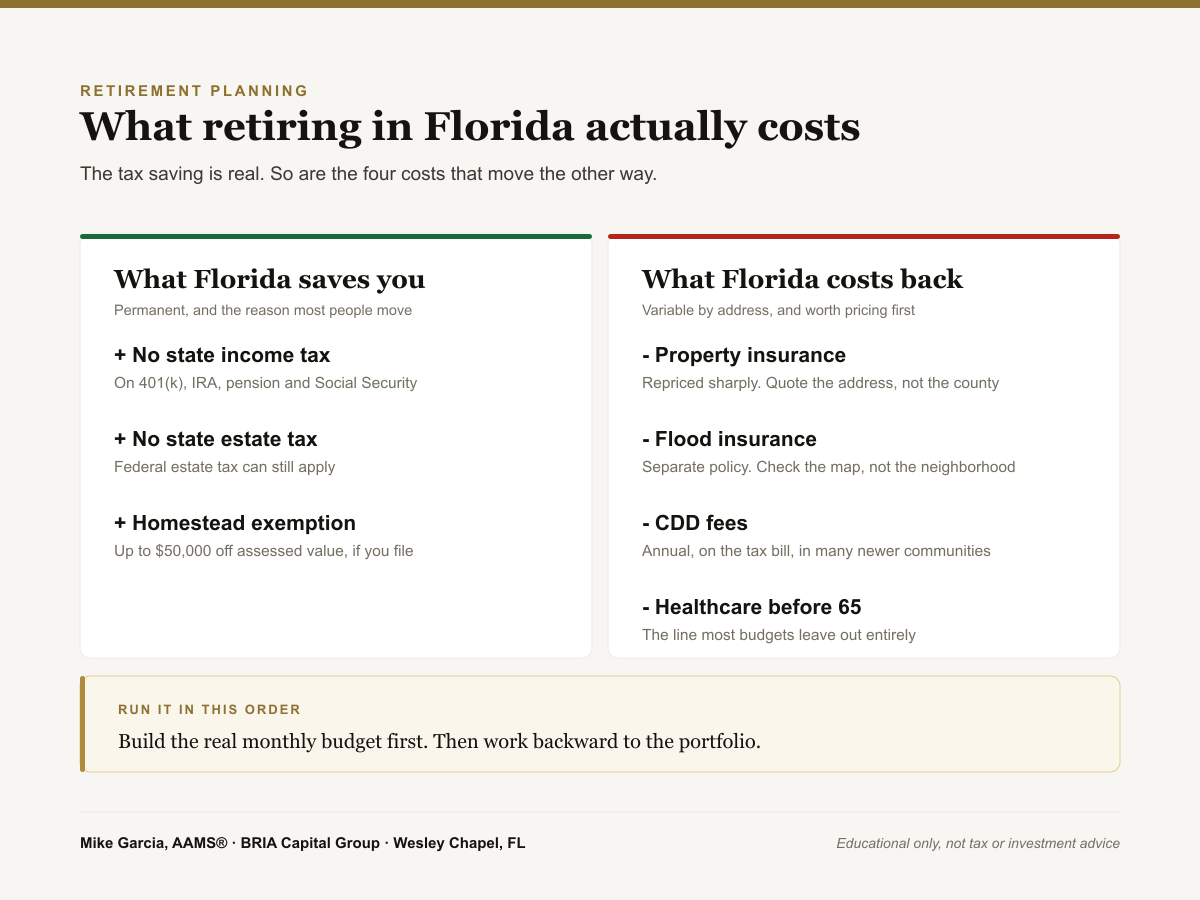
The pitch is simple enough that most people stop there. No state income tax, no state tax on Social Security, warm in February. Sell the house up north, buy something newer for less, and the difference funds the rest.
Part of that is true. The part that gets left out is that Florida moves several other costs in the opposite direction, and two of them have moved a long way in the last few years.
Here is the actual arithmetic.
What Florida genuinely saves you
No state income tax. Florida is one of nine states without an individual income tax. That means no state tax on 401(k) or IRA withdrawals, no state tax on pension income, and no state tax on Social Security. Federal tax still applies to all of it, but the state layer disappears entirely.
For someone drawing $80,000 a year in a state with a 5% income tax, that is roughly $4,000 a year that stays in the account. Over a 25-year retirement it compounds into real money.
No state estate tax and no inheritance tax. Florida has neither. The federal estate tax still applies above the exemption, and I wrote about what Florida heirs still owe because the assumption that Florida means tax-free inheritance is wrong more often than it is right.
The homestead exemption. Your primary residence gets up to $50,000 off its assessed value for property tax purposes, and filing also locks in the Save Our Homes cap, which limits how fast that assessed value can climb each year.
The catch is that you have to file for it. It is not automatic. New residents miss it constantly, and every year you miss is a year the cap does not start running.
What Florida costs you back
Property insurance
This is the line that has changed most, and it is the one people budget from memory rather than from a quote.
Florida’s property insurance market went through a hard cycle. Premiums climbed sharply, several carriers left the state, and while the market has been steadier through 2026 than it was in 2023 and 2024, the new baseline is well above where it sat a decade ago.
Two things follow from that. First, get an actual quote on the actual address before you commit to a purchase price, because the difference between an inland home and a coastal one can reshape the budget. Second, treat it as a cost to review annually rather than one you set once, and pay attention to the wind and hail deductible, which is often a percentage of the insured value rather than a flat dollar figure.
Flood insurance
Standard homeowners policies do not cover flood. If the property needs it, that is a separate policy and a separate premium.
Whether you need it is not only about being on the water. Flood maps get redrawn, and inland properties in low-lying areas can carry real exposure. Check the map for the specific address rather than the neighborhood.
CDD fees
Many of the newer communities across Pasco, Hillsborough, and the fast-growing suburbs are inside a Community Development District. The district issued bonds to build the roads, drainage, and amenities, and residents repay them through an annual assessment that arrives on the tax bill on top of property tax.
CDD fees vary widely by community and they are not optional. They are also easy to overlook when you are comparing two homes at the same asking price in different developments. Ask for the figure in writing before you sign.
Healthcare before Medicare
If you retire before 65, you are buying your own health coverage until Medicare starts. For a couple retiring at 62, that is three years of premiums that can reach five figures annually depending on the plan and subsidy eligibility.
This is the single largest line most people leave out of a Florida retirement budget, and it has nothing to do with Florida specifically. It just tends to surface when someone moves up their retirement date because the tax math looked good.
So how much do you actually need?
I am not going to give you a number, because any number quoted without knowing your spending is a guess wearing a suit.
What I can tell you is the order of operations, and most people run it backward.
The wrong way is to start with a portfolio balance, apply a withdrawal rate, and see whether the answer feels like enough. The right way is to build the monthly budget you actually expect to live on, in the specific place you plan to live, with real insurance quotes and the real CDD figure. Then work out what portfolio, withdrawal order, and Social Security timing support that number.
The second version takes longer and produces an answer you can rely on. That is the whole job of a retirement plan.
The Florida-specific planning that is worth doing
Roth conversions in the gap years. The window between retiring and starting Social Security or required distributions is often a low-income period. Converting traditional balances to Roth during those years, at a lower bracket, can reduce lifetime tax meaningfully. Florida’s lack of a state income tax makes the conversion cheaper than it would have been in your old state, which is a genuine reason to do it after the move rather than before.
Run the actual numbers with your CPA before converting, because the amount matters. Crossing into the next federal bracket or triggering higher Medicare premiums can undo the benefit. This is one of the clearest cases where an advisor and a CPA need to talk to each other.
Update the estate documents. Wills and trusts drafted in another state usually still work, but beneficiary designations, account titling, and homestead rules are state-specific, and Florida homestead law is unusual. Getting the estate side re-reviewed after a move is worth the afternoon.
Re-examine the insurance mix. Property and flood get the attention. Long-term care deserves more than it gets, because the cost of extended care is the risk most retirement plans do not survive, and it is easier to address at 60 than at 72.
Which part of Florida
The state is not one market. Coastal Pinellas prices insurance differently from inland Pasco. A newer community with a CDD prices differently from an established neighborhood without one. Property tax millage varies by county.
If you are comparing towns, price insurance, CDD fees, and property tax as a single annual number rather than three separate ones. The spread between two towns that look similar on a listing site is usually wider than people expect. I go through some of that comparison on the Wesley Chapel, Tampa, and Lutz pages.
Where this leaves you
Florida is a genuinely good place to retire for a lot of people, and the tax treatment is a real advantage rather than a marketing line. The mistake is treating that advantage as the whole answer instead of one input.
Price the insurance. Ask for the CDD figure. Cost out the years before Medicare. Then decide.
If you want a second set of eyes on whether the numbers work, book a 30-minute call. If it turns out you are already in good shape, that is a perfectly good outcome and I will say so.
This article is written by a licensed, credentialed advisor, not an anonymous content team. Securities and advisory services are offered through BRIA Capital Group, and Mike's license, employment history, and disciplinary record are public and searchable.

Financial advisor with BRIA Capital Group, serving Tampa Bay families and business owners from Wesley Chapel, FL. More about Mike or book a consultation.
Frequently asked questions
How much money do you need to retire comfortably in Florida?
There is no single number, because it depends entirely on the monthly spending you expect. What is specific to Florida is the shape of the costs rather than the total. No state income tax on your withdrawals works in your favor. Property insurance, flood coverage where it applies, and CDD fees in newer communities work against you. Build the actual budget you expect to live on, then work backward to the portfolio, Social Security timing, and withdrawal order that support it.
Does Florida tax retirement income?
No. Florida has no state individual income tax, so 401(k) and IRA withdrawals, pension income, and Social Security benefits are not taxed at the state level. Federal tax still applies to all of it. Florida also has no state estate tax and no inheritance tax, though the federal estate tax can still reach larger estates.
Is Florida actually cheaper to retire in than a high-tax state?
Often yes, but by less than the headline suggests. The income tax saving is real and permanent. It gets partly offset by property insurance, which has risen sharply across the state, by flood coverage where the property needs it, and by CDD fees in many newer developments. Whether you come out ahead depends on your income level and which county and community you land in, so it is worth pricing rather than assuming.
What is the Florida homestead exemption?
It reduces the assessed value of your primary residence for property tax purposes, up to $50,000, and it also locks in the Save Our Homes cap that limits how fast the assessed value can rise each year. You have to file for it, it does not apply automatically, and new residents miss it more often than you would expect. It is one of the simplest financial moves available to someone who has just moved to Florida.
What do people most often get wrong about retiring in Florida?
Budgeting the move on the tax saving alone. The second most common is treating property insurance as a fixed cost you set once, when it needs reviewing every year. The third is retiring before 65 without pricing health coverage for the gap years before Medicare, which for a couple can run into five figures annually and is the single largest line most people leave out.
Keep reading
A CPA and a financial advisor solve different problems, and the overlap is smaller than most people assume. Here is who to call, and when you need both.
What financial advisors actually charge, how each fee model works, and the questions that get you a straight answer before you sign anything.