How Much Does a Financial Advisor Cost? A Plain-English Breakdown
Most people asking this question have already been quoted a number. They just have no way to tell whether it is reasonable.
Advisor fees arrive in four or five different forms. Some are a percentage, some are a flat invoice, and some never appear on a statement at all. It is hard to judge a price when you cannot see all of it.
Here is how advisors actually get paid, what the ranges look like, and the questions that get you a straight answer.
The four ways advisors charge
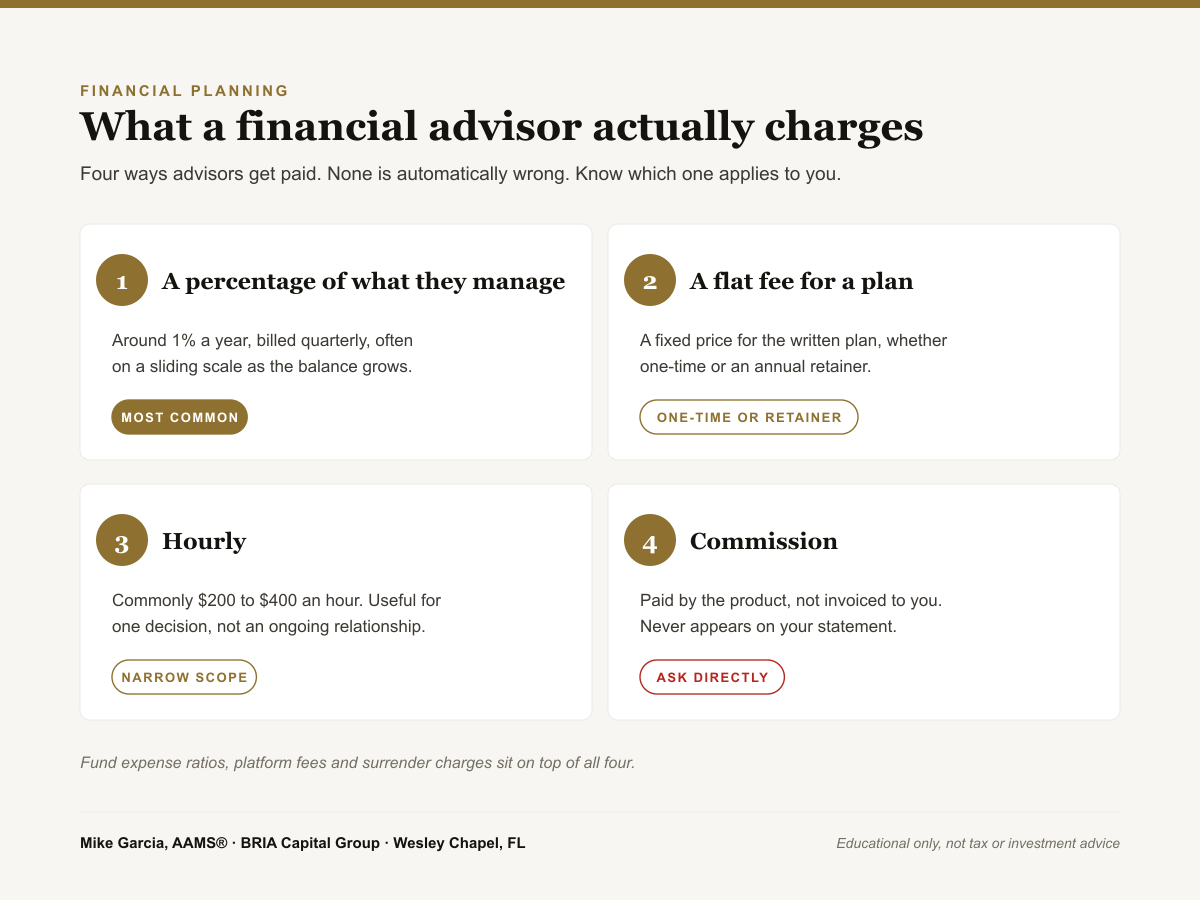
1. A percentage of what they manage
This is the most common arrangement for an ongoing relationship. The advisor charges an annual fee based on the value of the accounts they manage, usually billed quarterly.
Around 1% per year is the figure cited most often. Many firms use a sliding scale, so the rate drops as the balance grows: perhaps 1.25% on the first quarter million, 1% on the next, and lower from there.
On a $500,000 portfolio, 1% is about $5,000 a year, or roughly $1,250 per quarter.
The advantage is alignment. If your account grows, the advisor earns more. If it shrinks, they earn less. The drawback is that the fee is tied to your balance rather than the amount of work involved, and a large account does not always require proportionally more work.
2. A flat fee for a plan
Some advisors charge a fixed amount to build a financial plan, whether that is a one-time project or an annual retainer. These commonly land in the low thousands for a comprehensive plan, and higher when the situation involves a business, complex equity compensation, or estate work.
This model suits people who want the analysis and are comfortable executing it themselves.
3. Hourly
Less common, but useful for a specific question rather than an ongoing relationship. Rates generally fall between $200 and $400 an hour. If you need someone to review a pension election or sanity-check a rollover decision, paying for two hours can be far cheaper than paying a percentage forever.
4. Commission
With certain products, particularly insurance and annuities, the advisor is paid by the company issuing the product rather than by an invoice you receive. You will not see a line item on a statement.
Commission is not automatically a problem. Insurance has to be sold by someone, and the commission is built into how that industry works. It becomes a problem when it is not disclosed, or when the product recommended happens to be the one that pays the most.
Ask directly. A straightforward answer is a good sign in itself.
The fees most people never see
The advisory fee is the part everyone focuses on. It is often not the whole cost.
Fund expense ratios. Every mutual fund and ETF you hold charges its own internal fee. A broad index fund might charge 0.03% a year. An actively managed fund might charge 0.75% or more. These come out of the fund’s returns, so they never appear as a charge you pay.
Platform and custodian fees. The firm holding your accounts may charge its own administrative fee.
Trading costs. Mostly gone for stocks and ETFs at major custodians, but still present in some products.
Surrender charges. Some annuities and insurance contracts penalize you for taking money out during an initial period, sometimes lasting years.
Add these up and the difference between a well-built portfolio and an expensive one can be a full percentage point a year, before anyone has given you a single piece of advice. Over a few decades, that gap compounds into real money.
So is it worth it?
Depends entirely on what you need.
If your situation is simple, your income is steady, and you enjoy managing your own money, a low-cost index fund and a written plan will serve you well. Plenty of people do not need an advisor, and any advisor who tells you otherwise is selling.
Advice tends to earn its cost when the decisions get complicated or expensive to get wrong:
- Turning a retirement balance into income that lasts, in the right order, from the right accounts. This is the accumulation and distribution problem, and it is harder than it looks
- Timing Social Security against your other income, which sits at the center of most retirement plans
- Selling a business, or preparing one to be sold
- Sizing insurance so it covers the actual risk instead of the sales pitch
- Inheriting a large sum and needing to not make an irreversible mistake in the first six months
- Coordinating investments, taxes, and estate documents so they do not contradict each other
- Deciding what to do with an old workplace plan, where a 401(k) rollover is sometimes the right move and sometimes the wrong one
The pattern is that these are decisions where an error costs more than several years of fees.
The questions that get you a straight answer
Ask these before you sign. Write the answers down.
-
What is your fee, stated as a percentage and as a dollar amount? “About one percent” and “roughly six thousand dollars a year” are the same sentence. The second one is harder to gloss over.
-
What else am I paying that does not appear on your invoice? This is where expense ratios and product costs surface.
-
How are you compensated on anything you recommend to me? Covers commissions.
-
Are you acting as a fiduciary in this relationship, and when does that apply? The standard can apply to advisory work and not to other transactions. Ask them to be specific about which is which.
-
What exactly do I get for this fee each year? Reviews, tax coordination, plan updates, availability when something happens. Get it concrete.
-
What would make you tell me I do not need you? The answer tells you a lot.
Verify it yourself
You do not have to take anyone’s word for any of this. Two free public databases hold the record:
- FINRA BrokerCheck shows licensing, employment history, and any disciplinary record
- The SEC’s Investment Adviser Public Disclosure shows a firm’s Form ADV, which includes how it charges
Five minutes on either one tells you more than an hour of conversation. Any advisor worth hiring will point you there without hesitating.
If you want the longer version of how to evaluate someone, I wrote a practical checklist for choosing a financial advisor in Tampa Bay that covers credentials, fiduciary duty, and local fit.
One more thing people confuse
Advisor fees and accounting fees are separate, and so are the jobs. If part of what you are trying to solve is a tax question, that belongs with a CPA, not an advisor. I wrote about where the line falls between a CPA and a financial advisor, including the four situations where you genuinely need both.
Where this leaves you
Fees matter, but they are the second question. The first is whether the advice is worth having at all, and that depends on how complicated your situation actually is.
If you are trying to work out whether your current arrangement is reasonable, or whether you need ongoing help at all, book a 30-minute call. No pitch. If the answer is that you are fine on your own, that is a perfectly good outcome.
I work with families and business owners across Wesley Chapel, Tampa, Lutz, Lakeland and Ocala. You can see the full range of planning services if you want to know what an ongoing relationship actually covers.
This article is written by a licensed, credentialed advisor, not an anonymous content team. Securities and advisory services are offered through BRIA Capital Group, and Mike's license, employment history, and disciplinary record are public and searchable.

Financial advisor with BRIA Capital Group, serving Tampa Bay families and business owners from Wesley Chapel, FL. More about Mike or book a consultation.
Frequently asked questions
What is a normal fee for a financial advisor to charge?
The most common arrangement is an annual fee based on the assets the advisor manages for you, typically around 1% per year and often lower as the balance grows. Flat planning fees generally run in the low thousands for a one-time plan, and hourly rates commonly fall between $200 and $400. Commission-based products pay the advisor from the product itself rather than from a fee you write a check for. All of these are legitimate. What matters is knowing which one applies to you.
What is the average cost of using a financial advisor?
For an ongoing advisory relationship, roughly 1% of managed assets per year is the figure most often cited. On a $500,000 portfolio that is about $5,000 a year. Many advisors use a sliding scale, so the percentage drops as the balance rises. The honest answer is that the average matters less than your specific quote, because the range is wide and depends on the service you are actually getting.
Is it worth paying for a financial advisor?
It depends on what you need. If your situation is straightforward and you enjoy managing it, a low-cost index fund and a written plan may be enough. Advice tends to earn its cost when the decisions get complicated or expensive to get wrong: retirement income sequencing, tax strategy, business succession, insurance sizing, or inheriting a large sum. Ask any advisor to explain specifically what you get for the fee.
Are financial advisor fees tax deductible?
For most individuals, no. The Tax Cuts and Jobs Act suspended the miscellaneous itemized deduction that previously covered investment advisory fees, and that suspension runs through 2025 tax years under current law. Some fees paid inside certain business or trust structures may still be deductible. This is a question for your CPA, not your advisor.
How do I find out what my current advisor is charging me?
Ask for the fee in writing, stated two ways: as a percentage and as a dollar amount for the past twelve months. Then check your account statements for advisory fees, and read the fund expense ratios in your holdings. You can also look up any advisor's firm and disclosures for free on FINRA BrokerCheck and the SEC's adviser search.
Keep reading
No state income tax is real. So are the property insurance premiums, CDD fees, and pre-Medicare healthcare costs that people leave out of the budget.
A CPA and a financial advisor solve different problems, and the overlap is smaller than most people assume. Here is who to call, and when you need both.