CPA or Financial Advisor: What Each One Actually Does
People tend to hire whichever one they met first, then assume that person covers everything.
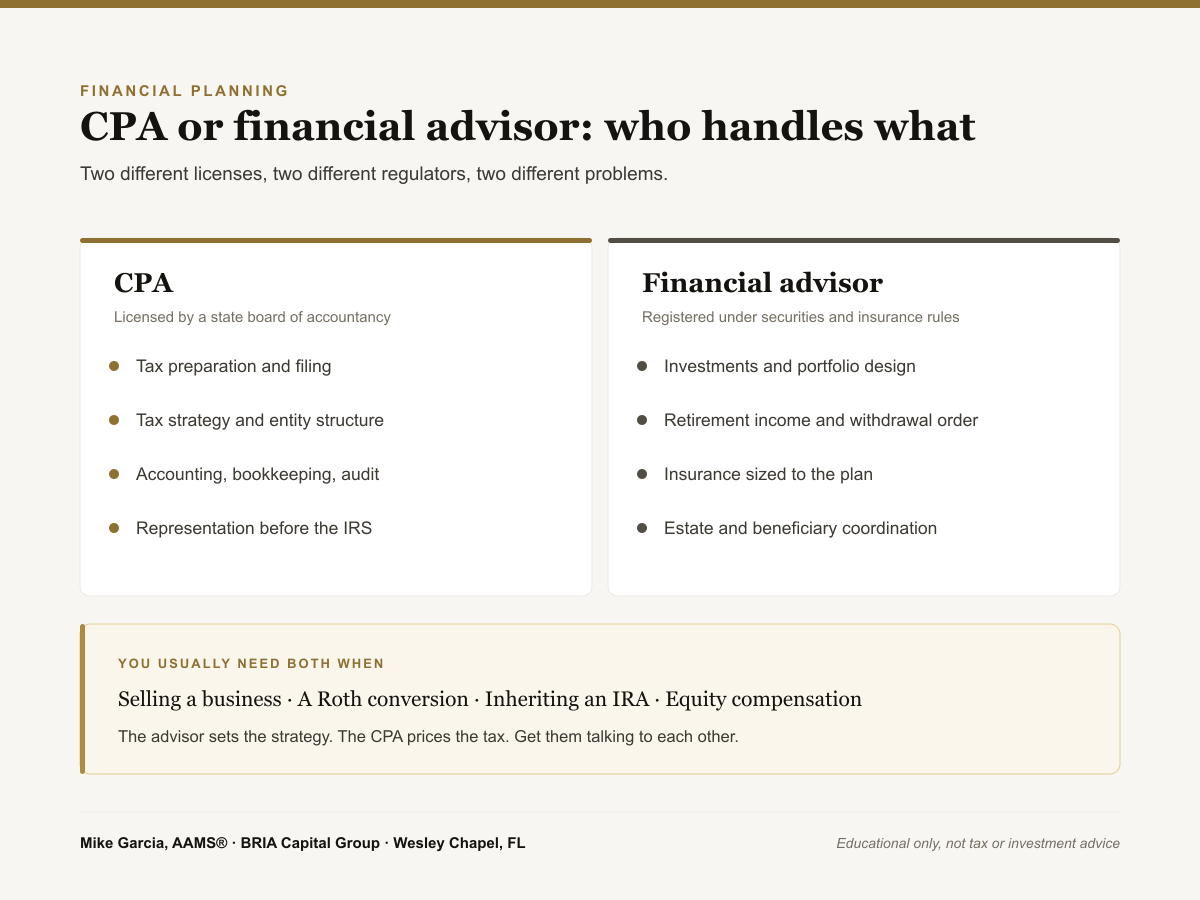
They do not. A CPA and a financial advisor operate under different licenses, answer to different regulators, and are trained to solve different problems. The overlap is real but narrower than most people expect, and the gap between them is where money quietly leaks out.
Here is what each one is actually for.
What a CPA does
A Certified Public Accountant is licensed by a state board of accountancy. Becoming one requires an exam, an education requirement, and documented experience. The license carries ongoing obligations.
Their core work:
- Tax preparation. Filing returns for individuals, businesses, trusts, and estates.
- Tax strategy. Structuring decisions to reduce what you owe, legally. Entity selection, timing of income and deductions, depreciation, retirement plan contributions on the business side.
- Accounting and audit. Financial statements, bookkeeping oversight, audits for organizations that need them.
- Representation. A CPA can represent you before the IRS. Most advisors cannot.
A CPA is generally backward-looking and compliance-driven by nature. They are working with transactions that already happened, and they are accountable for reporting them accurately. The good ones also plan forward, but the license is anchored in getting the record right.
What a financial advisor does
The title covers a wider range of roles, which is part of the confusion. What matters is the registration behind it.
Someone giving investment advice generally works under a securities registration such as the Series 7 and Series 66, or as an investment adviser representative of a registered firm, or both. Insurance products require separate state licensing. Designations such as the AAMS indicate additional training, but they are not licenses.
Their core work:
- Investments. Building and managing a portfolio around goals, timeline, and risk tolerance.
- Retirement income. Turning a balance into income that lasts, and deciding which accounts to draw from in which order.
- Risk. Sizing life, disability, and long-term care coverage against what the plan actually needs.
- Estate coordination. Beneficiary designations, account titling, and making sure the plan matches the legal documents.
- Business owner planning. Retirement plans, buy-sell funding, key person coverage, succession.
An advisor is generally forward-looking. The work is about decisions you have not made yet.
Where the line actually falls
The CPA tells you what a decision costs in tax. The advisor tells you whether the decision fits the plan.
Some concrete examples of that split.
Selling a business. The advisor works on what the proceeds need to do, how the owner replaces the income, what the timeline looks like. The CPA works on how the sale is structured, what is taxed as capital gain versus ordinary income, and what the bill looks like in the year it closes. Get one without the other and you can end up with a clean deal and an ugly April.
A Roth conversion. The advisor identifies the opportunity, typically in a low-income year before Social Security or required distributions begin. This is part of the wider accumulation and distribution question. The CPA runs the actual number, checks how much can be converted before crossing into the next bracket or triggering higher Medicare premiums. This is a decision that needs both people in the room.
Inheriting an IRA. The advisor handles what happens to the money and how it fits the beneficiary’s plan. The CPA handles the distribution rules and the tax consequence of the withdrawal schedule. Getting this wrong is expensive and not always reversible. The same coordination applies to a 401(k) rollover after a job change, which I covered in detail in what actually happens to your 401(k) when you leave a job.
Equity compensation. The advisor addresses concentration risk and when to diversify. The CPA addresses the tax treatment of the exercise and the timing that minimizes it.
Estate planning in Florida. Florida has no state estate tax, which leads people to assume there is no tax question at all. There usually is. I wrote about what heirs still owe in Florida, and the federal side of it is squarely CPA territory while the beneficiary and titling side is not.
The pattern repeats: one side is the strategy, the other is the bill.
When you only need one
Not every household needs both.
Probably just a CPA, or neither: Your taxes are a W-2 and a standard deduction. You contribute to a 401(k) at work and hold index funds. Nothing is changing this year. Filing software may be enough, and a CPA becomes useful mainly when something changes.
Probably just an advisor: Your taxes are simple but you have accumulated meaningful savings, you are within a decade of retirement, or you have money sitting in cash because you do not know what to do with it. The investment and income questions are the live ones.
Almost certainly both: You own a business. You hold equity compensation. You are within five years of retirement with multiple account types. You expect a significant inheritance. You own rental property. Your income varies a lot year to year.
Get them talking to each other
Hiring both professionals is only half the job. The value shows up when they coordinate.
The most common failure I see is a household with two competent people who have never spoken, each optimizing their own piece. The advisor recommends a move that creates a tax event nobody modelled. The CPA suggests a deduction that quietly undermines the retirement strategy. Both did their job. The household still lost.
If you work with both, give each one permission to contact the other, and expect them to use it. A fifteen-minute call between them once a year catches most of what falls through.
How to check anyone before you hire them
Both professions have public records. Use them.
- CPA: your state board of accountancy publishes license status and any disciplinary history. In Florida that is the Department of Business and Professional Regulation.
- Financial advisor: FINRA BrokerCheck and the SEC’s Investment Adviser Public Disclosure show licensing, employment history, and disclosures.
Ask what license the person actually holds, not what their business card says. The two are not always the same thing.
What each one costs
Fee structures differ between the two professions, and neither is transparent by default. CPAs typically charge per return or hourly. Advisors use one of four models, and I broke those down with typical ranges in how much a financial advisor costs. If you are comparing quotes from both, read that one first so you are comparing like with like.
Where to start
If you are trying to work out which side of the line your question falls on, book a 30-minute call. If it turns out to be a tax question, I will tell you to call a CPA, and I am happy to talk to them directly once you have one.
For the planning side, you can see how the pieces fit together across retirement, investments, business planning, risk and insurance, and estate coordination. If you are still deciding who to work with, the checklist for choosing an advisor in Tampa Bay covers what to ask.
I work with families and business owners in Wesley Chapel, Tampa, Lutz, Lakeland and Ocala.
This article is written by a licensed, credentialed advisor, not an anonymous content team. Securities and advisory services are offered through BRIA Capital Group, and Mike's license, employment history, and disciplinary record are public and searchable.

Financial advisor with BRIA Capital Group, serving Tampa Bay families and business owners from Wesley Chapel, FL. More about Mike or book a consultation.
Frequently asked questions
Is a CPA better than a financial advisor?
Neither is better. They solve different problems. A CPA handles tax preparation, tax strategy, and accounting, and is licensed by a state board. A financial advisor handles investments, retirement income, insurance, and long-term planning. Most households with any complexity end up working with both, and the value comes from having them talk to each other.
Can a CPA give investment advice?
Only if they also hold the appropriate securities registration or investment adviser registration. The CPA credential by itself does not authorize investment advice. Some professionals hold both, and a CPA with a Personal Financial Specialist credential has additional planning training. Ask what licenses someone actually holds rather than assuming the credential covers it.
Do I need both a CPA and a financial advisor?
If you own a business, hold equity compensation, are approaching retirement, or expect an inheritance, usually yes. The decisions in those situations have both an investment side and a tax side, and getting one right while ignoring the other is how people end up with an avoidable tax bill. If your taxes are a single W-2 and standard deduction, a CPA may be optional.
Which one should I hire first?
Hire for whichever problem is most urgent. If you are behind on taxes or facing an audit, start with the CPA. If you have money sitting uninvested or a retirement date approaching, start with the advisor. Then introduce them to each other.
What is the difference between a CPA and a CFP?
A CPA is a licensed accountant, credentialed by a state board, focused on tax and accounting. A CFP is a certified financial planner, credentialed by the CFP Board, focused on comprehensive financial planning. They are different professions with different exams and different regulators. Some people hold both.
Keep reading
No state income tax is real. So are the property insurance premiums, CDD fees, and pre-Medicare healthcare costs that people leave out of the budget.
What financial advisors actually charge, how each fee model works, and the questions that get you a straight answer before you sign anything.