What Actually Happens to Your 401(k) When You Leave a Job (And the 4 Options Nobody Explains Clearly)
When you leave a job, whether you were laid off, took a new role, or finally started the business you always talked about, your old 401(k) doesn’t just disappear. It sits there, still invested, still yours. And at some point you’ll get a letter, an email, or a phone call asking what you’d like to do with it.
That’s usually where the confusion starts. Most of the guidance you’ll find online comes from companies that make money when you move your account to them, so they tend to push one answer: roll it over to an IRA. Sometimes that’s exactly right. Sometimes it’s the most expensive mistake you can make. The honest answer depends on your age, your next employer’s plan, and what you’re trying to protect.
Here’s a plain-English breakdown of what actually happens to your 401(k) when you leave a job, the four real options you have, and the rules that quietly cost people money along the way.
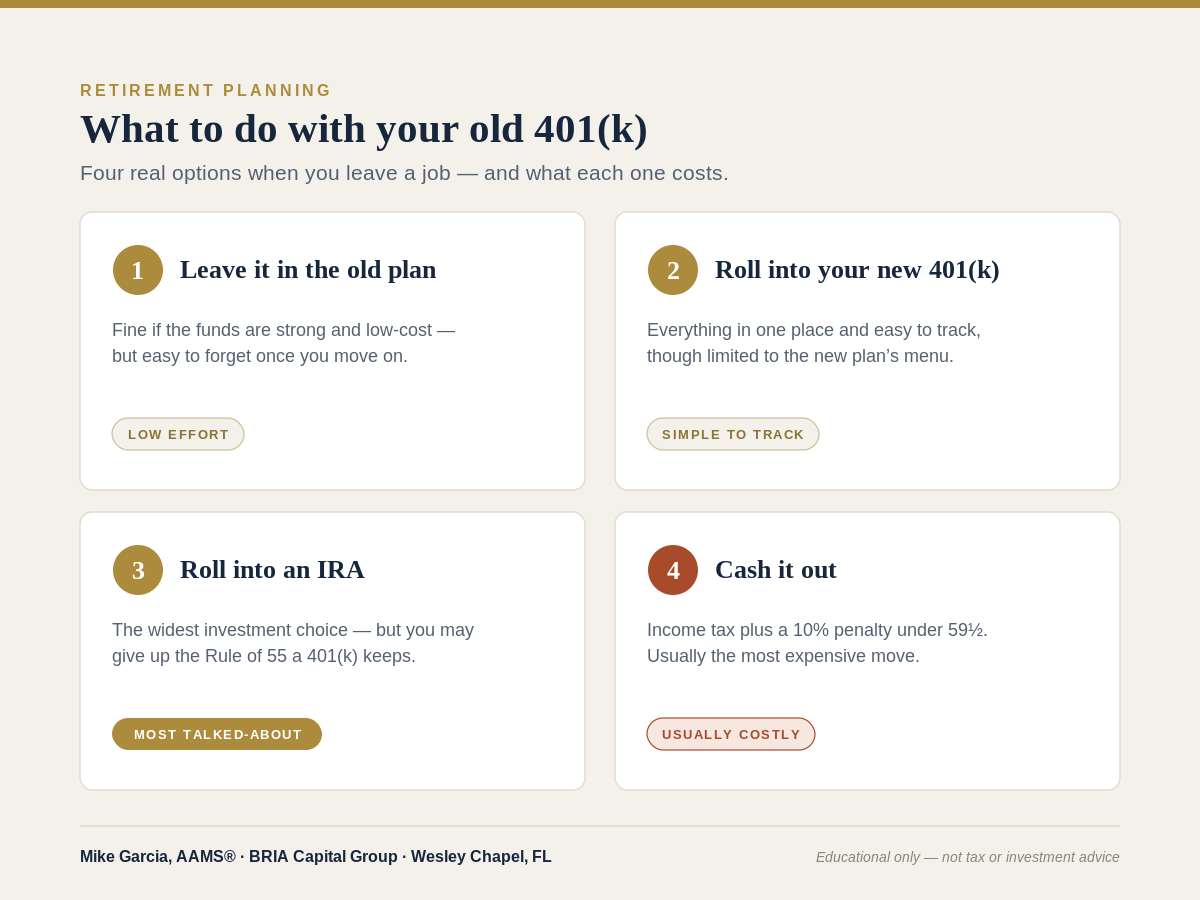
At a glance, you have four options:
- Leave it in your old employer’s plan
- Roll it into your new employer’s 401(k)
- Roll it into an IRA (the “401k rollover to IRA”)
- Cash it out, usually the most expensive move
The rest of this guide walks through each one, plus the direct-vs-indirect rule and the Rule of 55 that quietly cost people money.
First, the good news: your money is still yours
Your 401(k) contributions, and any employer match that has vested, belong to you the moment you leave. Nobody can take them. What changes is that you can no longer contribute to that specific plan, and depending on your former employer’s rules, you may be nudged (or required) to make a decision within a certain window.
If your vested balance is under a threshold your plan sets (often $7,000 under current rules), the plan may automatically cash you out or roll your balance into an IRA for you. That’s exactly the kind of default you don’t want happening by accident, because it can trigger taxes and penalties you never agreed to. So the first step is simple: know your balance, and don’t ignore the paperwork.
Option 1: Leave it in your old employer’s plan
The path of least resistance is to do nothing and leave the money where it is. This is a legitimate option, not just laziness, and in some cases it’s the smartest one.
You might leave it where it is if the old plan has excellent, low-cost institutional funds you can’t easily replicate, or if you’re between the ages of 55 and 59½ and just separated from that employer (more on why that matters below). The downside is that you now have a retirement account you’re no longer actively managing, sitting with a company you no longer work for. People forget about these accounts all the time, and a forgotten account is one that never gets rebalanced as you get older.
Option 2: Roll it into your new employer’s 401(k)
If you’re starting a new job with a 401(k), you can often roll your old balance into the new plan. This consolidates your retirement savings into one account, which makes your money far easier to track and manage. It also keeps the door open to a couple of 401(k)-specific advantages, like the ability to borrow against your balance and, in some cases, stronger protection from creditors.
The catch is that you’re limited to the new plan’s investment menu, and not all plans accept incoming rollovers. It’s worth asking the new plan’s administrator two questions before you move anything:
- Do you accept incoming rollovers?
- What do the fund options and fees actually look like?
Option 3: Roll it into an IRA, the “401k rollover to IRA”
This is the option you’ll hear about most, and for good reason. Rolling your old 401(k) into an Individual Retirement Account (IRA) usually gives you the widest range of investment choices, often at lower cost, and puts all of it under one roof you control rather than one your ex-employer controls.
A rollover to an IRA can make sense when you want investment flexibility your old plan didn’t offer, when you’re consolidating several old accounts into one, or when you want to build a coordinated retirement income strategy rather than a scattered pile of accounts. For a lot of people leaving a job, this is the right call.
But this is the part the brochures skip: it isn’t automatically right. If you roll to an IRA, you may give up the “Rule of 55” and certain creditor protections that a 401(k) provides. Whether the trade is worth it depends entirely on your situation, which is exactly the conversation worth having before you sign anything.
Option 4: Cash it out (usually the expensive one)
You can also simply take the money. For most people under 59½, this is the option to avoid. If you cash out a traditional 401(k) before that age, the distribution is generally added to your taxable income for the year and hit with a 10% early-withdrawal penalty on top. Between federal income tax and the penalty, it’s not unusual to lose a third or more of the balance, and you permanently give up decades of tax-advantaged growth on money you’ll want in retirement.
There are narrow exceptions, but “I want to pay off a credit card” or “I could use the cash right now” almost never survives the math. If you’re in a genuine financial bind, it’s worth talking through alternatives before you touch retirement money.
The rule that costs people money: direct vs. indirect rollover
If you decide to move your 401(k), how you move it matters enormously. There are two ways, and confusing them is one of the most common, and most avoidable, mistakes.
A direct rollover (sometimes called a trustee-to-trustee transfer) means the money goes straight from your old plan to your new account. You never touch it. There’s no withholding and no tax event. This is almost always the way to do it.
An indirect rollover means the plan sends the check to you, and you’re responsible for depositing it into the new account. Here’s the trap: when an employer plan cuts you that check, it’s generally required to withhold 20% for taxes. So if you have $100,000, you receive $80,000, but to complete a full rollover and avoid taxes, you have to deposit the entire $100,000 into the new account, making up that missing $20,000 out of your own pocket, and then wait to recover it at tax time. Miss that, and the shortfall is treated as a taxable distribution.
When an eligible rollover distribution is paid directly to you (an indirect rollover), the plan is generally required to withhold 20% for federal taxes. A direct trustee-to-trustee transfer avoids that withholding entirely. Distributions taken before age 59½ are generally subject to an additional 10% early-withdrawal tax unless an exception, such as the Rule of 55, applies.
The lesson is simple: whenever possible, choose a direct rollover and never let the check come to you.
Every 401(k) decision depends on your age, your new plan, and your tax year. Let's walk through yours together, in plain English, before you sign anything.
Book a free 30-minute callThe 60-day rollover rule
If you do end up with an indirect rollover (the check comes to you), the clock starts immediately. Under the 60-day rollover rule, you have 60 days from the day you receive the funds to redeposit them into a qualifying retirement account. Miss the deadline, and the IRS generally treats the entire amount as a taxable distribution, plus the 10% penalty if you’re under 59½.
Sixty days sounds like plenty of time until life gets in the way. This is another reason a direct rollover is the safer default: there’s no 60-day window to blow, because you were never holding the money in the first place.
Can I roll over my 401(k) to a Roth IRA?
Yes, but understand the tax bill first. A traditional 401(k) is funded with pre-tax dollars, while a Roth IRA holds after-tax dollars that grow tax-free. When you roll pre-tax 401(k) money into a Roth IRA, you’re doing a Roth conversion, and the amount you convert is added to your taxable income for that year.
For the right person, that’s a feature, not a bug: you pay tax now, in a year when your income may be lower, in exchange for tax-free withdrawals in retirement. For someone in a high-earning year, converting a large balance could push you into a higher bracket unnecessarily. The decision is all about timing and tax brackets, the kind of thing worth modeling out before you pull the trigger, not after.
The nuance almost nobody mentions: the Rule of 55
Here’s the one that catches people who rolled too fast. If you leave your job in or after the calendar year you turn 55, the IRS lets you take distributions from that employer’s 401(k) without the usual 10% early-withdrawal penalty. That’s the “Rule of 55.”
But it only works from the 401(k). The moment you roll that balance into an IRA, the penalty-free age snaps back to 59½. So if you’re 56, recently separated, and think you might need to tap that money before 59½, rolling everything into an IRA could quietly cost you the 10% penalty you were trying to avoid. This is a perfect example of why “just roll it over” is bad blanket advice: the right move genuinely depends on your age and your plans.

The two most expensive 401(k) moves I see Tampa Bay families make are cashing out early and doing an indirect rollover by accident. Both are almost always avoidable with one phone call before you sign anything. If you just left a job and have an old 401(k) sitting out there, let's spend 30 minutes making sure your next move fits your age, your new plan, and your tax picture, not a script.
So which option is right for you?
There’s no universal answer, and anyone who gives you one without asking about your situation is selling something. The right choice comes down to a handful of questions:
- How old are you, and did you just separate from this employer?
- Does your new job offer a strong 401(k)?
- Do you value investment flexibility or creditor protection more?
- Are you thinking about a Roth conversion, and if so, is this the right tax year for it?
Those are the questions we work through together, in plain English, with your actual numbers, not a script. If you recently left a job in Wesley Chapel, Tampa, or anywhere across Tampa Bay and you’re staring at that 401(k) paperwork wondering what to do, that’s exactly the kind of decision worth a conversation before you act.

Learn more about how we approach 401(k) rollovers, explore our full retirement planning services, or book a no-pressure 30-minute call to talk through your options. You can also read more about Mike’s background, including the 20+ years he spent as a business owner before becoming an advisor.
Mike Garcia, AAMS®, is a financial advisor with BRIA Capital Group, serving families and business owners in Wesley Chapel and across Tampa Bay from an office at 2044 Ashley Oaks Cir #102, Wesley Chapel, FL 33544.
This article is for general educational and informational purposes only and is not intended as, and should not be relied upon as, individualized tax, legal, or investment advice. Rules governing retirement accounts, rollovers, and early distributions are complex, contain exceptions, and can change. Neither Mike Garcia nor BRIA Capital Group provides tax or legal advice; please consult a qualified tax advisor or attorney about your specific situation before making any decisions. Investing involves risk, including the potential loss of principal. Securities and advisory services offered through BRIA Capital Group.
This article is written by a licensed, credentialed advisor, not an anonymous content team. Securities and advisory services are offered through BRIA Capital Group, and Mike's license, employment history, and disciplinary record are public and searchable.
Financial advisor with BRIA Capital Group, serving Tampa Bay families and business owners from Wesley Chapel, FL. More about Mike or book a consultation.
Frequently asked questions
What happens to my 401(k) when I leave a job?
It stays invested and remains yours. You generally have four options: leave it in your old employer's plan, roll it into your new employer's 401(k), roll it into an IRA, or cash it out. The right choice depends on your age, your new plan, and your tax situation.
Is a direct or indirect rollover better?
A direct (trustee-to-trustee) rollover is almost always better. The money moves straight between accounts with no withholding and no tax event. An indirect rollover sends the check to you, triggers a mandatory 20% withholding, and starts a 60-day clock to redeposit the full amount.
What is the 60-day rollover rule?
If you receive 401(k) funds directly (an indirect rollover), you have 60 days to redeposit them into a qualifying retirement account. Miss the deadline and the IRS generally treats the whole amount as a taxable distribution, plus a 10% penalty if you're under 59½.
Can I roll my 401(k) into a Roth IRA?
Yes, but it counts as a Roth conversion, so the amount you convert is added to your taxable income for that year. It can be smart in a lower-income year in exchange for tax-free withdrawals later, but it should be planned around your tax bracket.
What is the Rule of 55?
If you leave your job in or after the calendar year you turn 55, you can take penalty-free distributions from that employer's 401(k). It only works from the 401(k); rolling the balance into an IRA snaps the penalty-free age back to 59½.
Should I cash out my old 401(k)?
Usually not. Cashing out before 59½ generally means income tax plus a 10% early-withdrawal penalty, often a third or more of the balance, and you give up decades of tax-advantaged growth. It's worth exploring alternatives first.
Keep reading
No state income tax is real. So are the property insurance premiums, CDD fees, and pre-Medicare healthcare costs that people leave out of the budget.
A CPA and a financial advisor solve different problems, and the overlap is smaller than most people assume. Here is who to call, and when you need both.